What is the Proper Placer Sample Size?
“How large should a placer sample be to insure an accurate determination of the grade?” This has been the subject of placer miners and evaluators for years. The geo-statisticians have weighed in with possible answers. Unfortunately their statistical standard is not realized until after the sample has been cut, concentrated, weighed, and the colors counted. Is there a better way? Yes, possibly. This essay delves into placer gold sample size and how to do better sampling of gold placers.
First let’s review the principles of placer sampling. A sample attempts to take a small portion of something much larger in hopes of fairly representing the entire body, or in this case an orebody. Sampling produces best results if the mineral particles are consistently sized and evenly distributed throughout the material. Unfortunately this is never the case in gold placer deposits. In the real world the gold is in various sizes that range from large nuggets to flour size within one placer. Nuggets are much rarer than finer particles. Fine gold is much easier to find than are nuggets, but when a nugget is captured; it can make a huge impact of the grade of the sample a.k.a. the nugget effect. A large nugget will affect the grade of a small sample much more than on a large sample. Small samples have a much better chance of missing any gold due to gold’s scarcity. As a result the statisticians have come up with the concept that for statistical reliability the samples need to be large enough to contain at least 20 gold particles in each mesh size. This is a short order for flour gold, but a very tall order for gold nuggets. The rule of thumb is the larger the gold particle size expected, the larger the sample should be.
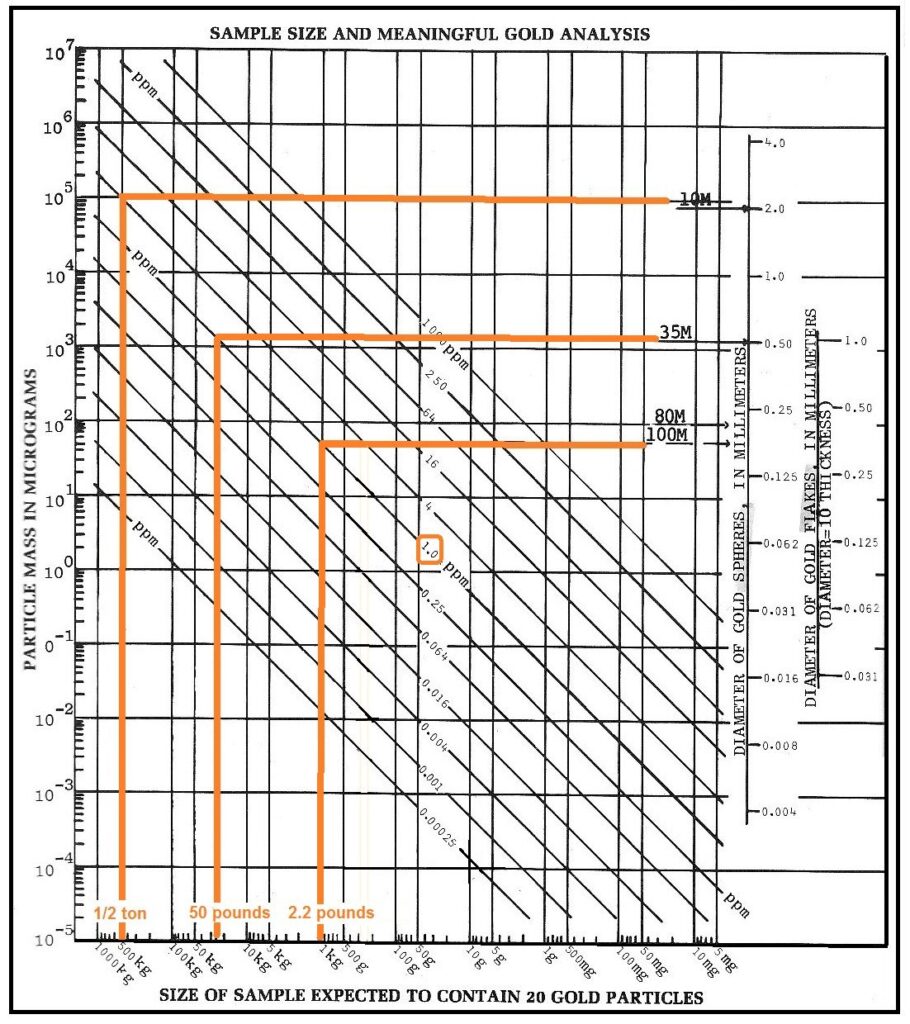
Figure 1 is a statistician’s logarithmic graph of gold particle size versus sample size. Twenty particles are the barest minimum number to have a 95% certainty. Not every mesh size must have 20 gold particles retained; as there are 40 Tyler screens between their coarsest, at about 1 inch openings, to their finest at 400 mesh or 38 microns. Rather only the economically important gold sizes need to have a minimum of 20 particles. In most placer mines those sizes are retained on 10, 35 and 100 mesh screens.